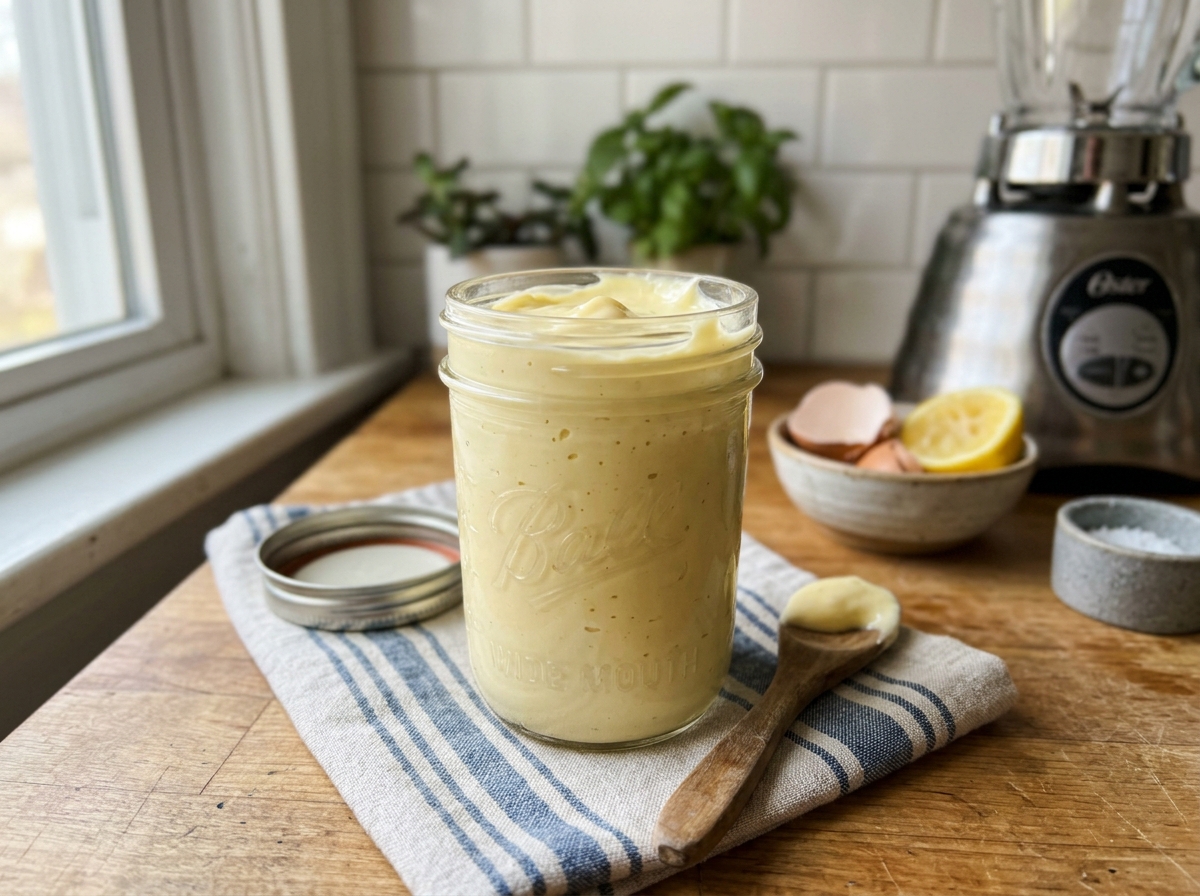
Blender Healthy Avocado Oil Mayonnaise
The most common failure when making homemade mayonnaise is a broken emulsion that leaves you with a separated, greasy pool of oil. We solve this problem by pairing room-temperature ingredients with the high-shear vortex of a standard blender and a controlled oil stream. Using avocado oil instead of processed seed oils gives you a rich, heart-healthy spread that thickens into a glossy, spoonable cream in under five minutes.
The Science of a Stable Blender Emulsion
Mayonnaise is a physical force-blend of two ingredients that normally refuse to mix: fat and water. The water base comes from egg white, lemon juice, and mustard, while the fat comes from the oil. To hold these liquids together without separating, we rely on natural emulsifiers and mechanical shear force.
Egg yolk contains lecithin, a fat-soluble and water-soluble molecule that coats microscopic oil droplets and keeps them suspended in water. Dijon mustard contributes plant mucilage, which reinforces the bonds between the oil and liquid phases. When you blend these ingredients, high-speed blades chop the oil into tiny droplets while lecithin wraps around each one.
Temperature plays a crucial role in this process. Cold oil or cold eggs cause fat molecules to stiffen, making it difficult for the blender blades to break them into uniform droplets. Keeping every ingredient at room temperature allows the molecules to bind instantly, creating a stable network that will not separate in your refrigerator.
Choosing Healthy Oils and Pantry Staples
Every ingredient in a simple mayonnaise has a job to do. Because this spread relies on raw pantry staples, quality and temperature determine both your success and flavor.
- Avocado Oil: This is our preferred oil for a healthy mayo. It provides clean monounsaturated fats and a light, neutral flavor profile. Trade-off: High-quality avocado oil costs more than vegetable oil, but it avoids the industrial refining of soybean oil.
- Large Whole Egg: Fresh eggs provide both the lecithin emulsifier from the yolk and moisture from the white. Trade-off: Using a whole egg creates a slightly lighter spread than yolk-only recipes, but it blends much faster in high-speed blenders.
- Dijon Mustard: Beyond flavor, Dijon acts as a chemical stabilizer for the emulsion. Trade-off: Yellow hot dog mustard works in a pinch, but it adds a sharp vinegar bite and bright yellow color.
- Fresh Lemon Juice: Acid brightens the heavy fat flavor and lowers the pH of the mixture, which helps preserve the mayo. Trade-off: White distilled vinegar works well if you want a neutral, store-bought flavor, but fresh lemon juice gives a cleaner taste.
- Fine Sea Salt: Fine grains dissolve quickly into the egg liquid before the oil is introduced. Trade-off: Coarse kosher salt may leave gritty undissolved crystals in the finished spread.
Visual and Sensory Cues for a Thick Blend
Watching and listening to your blender ensures perfect texture without overworking the emulsion. Pay attention to how the sound and movement change inside the blender jar during the process.
First, blend the egg, acid, mustard, and salt until frothy. You should see light yellow foam with tiny air bubbles covering the blades. This creates the wet landing pad for your oil stream.
Next, begin trickling the oil into the center hole of the blender lid. The stream must be no wider than a thin pencil lead for the first 30 seconds. You will notice a pale ring forming around the spinning blades as the liquid shifts from yellow to cream.
As you add the remaining oil, the blender motor will change pitch. The high whine of empty blades turns into a low, muffled thrum as friction increases. The mixture will stop sloshing and form soft, pillowy waves that hold their shape against the glass walls.
Common Mistakes and How to Avoid Them
Making mayonnaise in a blender is fast, but minor mistakes can cause the emulsion to break into oily liquid. Here is how to prevent common problems and fix them if things go wrong.
Flavor Variations for Dips and Spreads
Once you master the basic neutral mayonnaise base, you can flavor it for sandwiches, wraps, roasted vegetables, and salad dressings.
- Roasted Garlic Aioli: Add 3 cloves of soft roasted garlic and 1/4 teaspoon of cracked black pepper to the egg base before blending the oil.
- Smoky Chipotle Lime: Swap the fresh lemon juice for lime juice. Add 1 teaspoon of adobo sauce from canned chipotle peppers and 1/2 teaspoon of ground cumin.
- Fresh Garden Herb: After the mayonnaise finishes blending, turn off the machine and fold in 2 tablespoons of finely minced fresh dill, chives, and flat-leaf parsley using a spatula.
- Spicy Sriracha Mayo: Whisk 1 tablespoon of Sriracha sauce and 1/2 teaspoon of pure toasted sesame oil into the finished mayo for sushi rolls or chicken sandwiches.
Storage and Food Safety Guidelines
Fresh homemade mayonnaise lacks the commercial preservatives found in store jars, so proper chilling and storage are essential for safety and quality.
Transfer your finished mayo into a clean glass jar with a tight lid immediately after blending. Keep it stored on an interior refrigerator shelf where temperatures stay consistently at 38°F or below. Used within 7 to 10 days, your spread will remain fresh, safe, and thick.
Never freeze homemade mayonnaise. Freezing breaks the emulsion by forming ice crystals that rupture the lipid bonds. When thawed, the mayo will separate into water and yellow oil that cannot be re-emulsified. If your mayonnaise softens after sitting on the counter during a meal, chill it in the fridge for 1 hour to restore firm texture.
Frequently Asked Questions
Can I use an immersion blender instead of a countertop blender?
Yes, you can make this recipe using a standard immersion blender. Place all ingredients—including the oil—into a narrow jar that just fits the immersion blender head. Place the blender wand at the very bottom, run it on high speed for 10 seconds until white emulsion forms at the base, then slowly pull the wand upward to draw in the remaining oil.
Is it safe to consume homemade mayonnaise made with raw eggs?
Raw eggs carry a small risk of Salmonella contamination. If you are serving elderly family members, pregnant women, or young children, buy pasteurized eggs in the shell at your local grocery store. You can also pasteurize eggs at home by holding them in a 140°F water bath for exactly 3.5 minutes.
How long does homemade healthy mayonnaise stay fresh in the fridge?
Store your fresh avocado oil mayonnaise in a sealed glass container in the coldest part of your refrigerator, set to 38°F or below. It stays fresh and stable for 7 to 10 days. Always smell the jar and check for visual separation before serving.
Why did my mayonnaise taste bitter when I used olive oil?
Extra virgin olive oil contains high levels of polyphenols. High-speed blender blades tear these chemical compounds apart, releasing bitter flavor compounds and breaking the emulsion. If you want olive oil flavor, blend with neutral avocado oil first, then gently whisk in light olive oil by hand at the end.
Blender Healthy Avocado Oil Mayonnaise
Ingredients
Equipment
Method
- Remove the egg from the refrigerator 30 minutes before prep to bring it to room temperature. Alternatively, submerge the whole egg in a bowl of warm tap water for 5 minutes.
- Add the room-temperature egg, lemon juice, Dijon mustard, and fine sea salt to the bottom of a clean, dry blender pitcher.
- Secure the blender lid, removing the center lid cap. Blend the egg mixture on medium speed for 15 seconds until pale yellow, frothy, and completely uniform.
- With the blender running on medium speed, begin pouring the avocado oil into the center hole in a pencil-thin, continuous stream. Take a full 90 to 120 seconds to pour the entire cup of oil.
- Listen for the motor pitch to deepen as the mixture thickens into an opaque, glossy cream. Once all oil is incorporated, turn off the blender immediately.
- Scrape down the sides of the blender with a silicone spatula. Taste and add up to 1 extra teaspoon of lemon juice or a pinch of salt if desired, pulsing once to combine.
- Transfer the finished mayonnaise into a clean glass jar, seal tightly, and chill in the refrigerator for at least 30 minutes before serving.