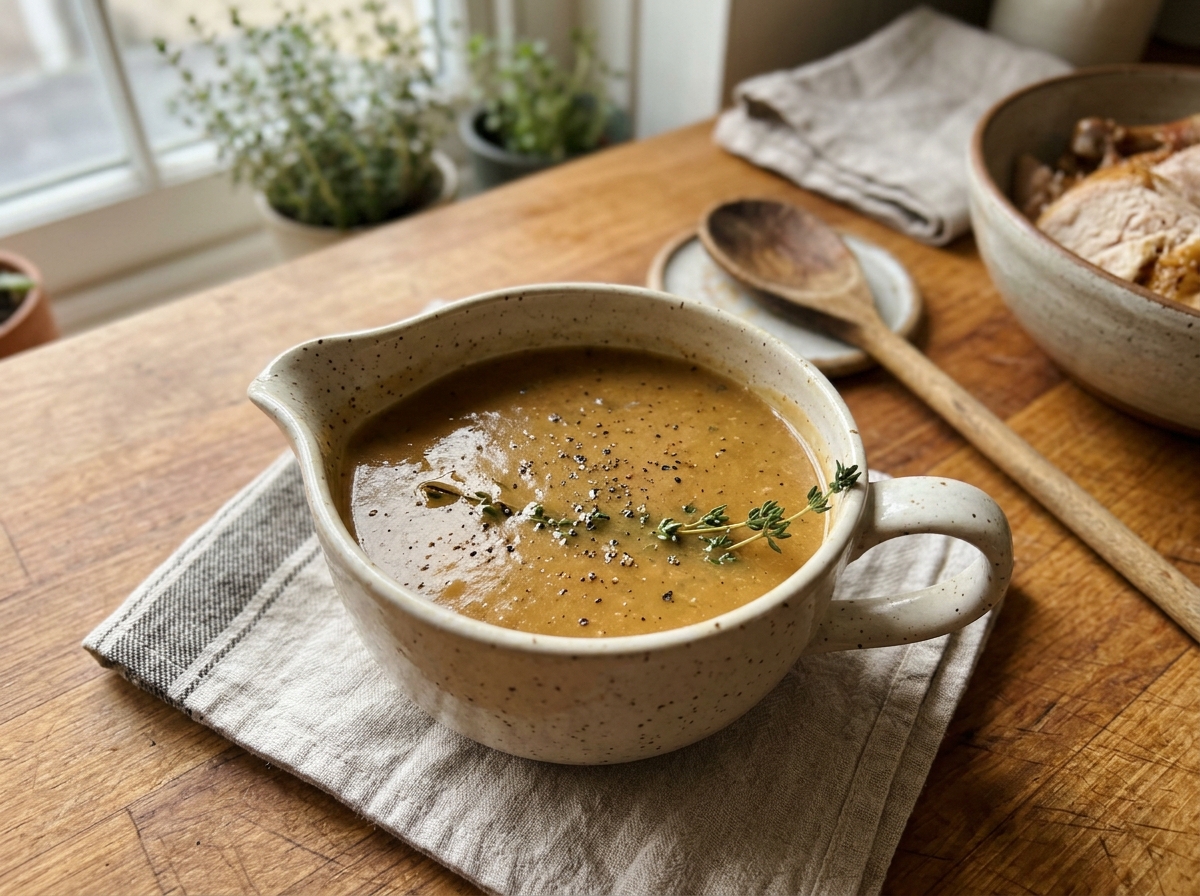
Homemade Turkey Gravy
Searing turkey giblets and neck directly in the saucepan before building your base unlocks deep roasted flavor long before the turkey leaves the oven. Combining this concentrated stock with the caramelized pan fond from your roasting pan yields a smooth sauce without relying on heavy thickeners. We use a precise fat-to-flour ratio that eliminates raw starch taste while keeping the texture light and velvety.
The Science Behind Smooth, Rich Turkey Gravy
Making great turkey gravy depends on three critical chemical reactions: starch gelatinization, fat emulsification, and Maillard browning. Understanding how these elements interact keeps your gravy from turning lumpy, greasy, or thin.
First, the roux relies on equal parts fat and all-purpose flour cooked together. When you cook flour in fat, the fat coats the individual starch granules. This physical barrier prevents the starch molecules from clumping together when hot turkey stock is added later. As the liquid heats to around 175°F to 185°F, the starch grains swell and absorb liquid, a process called gelatinization. Cooking the roux for at least two minutes before adding liquid also breaks down raw starch enzymes, eliminating that pasty taste.
Second, pan fond provides deep savory flavor through Maillard browning. The browned bits stuck to the bottom of your roasting pan are caramelized proteins and sugars. Deglazing the pan with warm stock dissolves these solids, suspending them in the liquid base.
Finally, controlling fat emulsification prevents an oily sheen on top of your gravy bowl. Drippings contain both liquid fat and nutrient-rich turkey juices. Skimming off excess rendered turkey fat and supplementing with whole butter creates a stable emulsion that stays smooth as it cools.
Key Ingredients and Smart Substitutions
Every ingredient in turkey gravy serves a distinct structural or flavor purpose. Choosing the right components ensures your liquid sets properly without masking the natural pan flavors.
- Turkey Pan Drippings and Fond: This is the concentrated liquid and browned bits left in the roasting pan after the bird finishes. Drippings provide authentic turkey flavor and natural gelatin. Substitution: If you lack pan drippings, use rich roasted turkey stock combined with 2 tablespoons of melted unsalted butter. Trade-off: You lose the roasted background notes from the pan bottom.
- Turkey Stock or Low-Sodium Chicken Broth: Stock provides liquid volume and body. Homemade turkey stock made from roasted giblets and neck works best. Substitution: Store-bought low-sodium chicken broth. Trade-off: Commercial broth lacks natural gelatin, so the finished sauce will have a slightly lighter body.
- Unsalted Butter: Fat coats the flour during roux preparation and adds shine during the final finish. Using unsalted butter lets you control the salinity of concentrated pan drippings. Substitution: Rendered turkey fat skimmed from drippings. Trade-off: Pure turkey fat makes a savory gravy but can separate more easily if overheated.
- All-Purpose Flour: Wheat flour acts as the primary thickener through starch bonding. Substitution: Sweet rice flour or cornstarch. Trade-off: Cornstarch produces a glossier, clearer sauce with a thinner mouthfeel and cannot be boiled vigorously without breaking down.
- Fresh Herbs (Thyme and Sage): Small sprigs of fresh woody herbs add earthy aroma without overwhelming the gravy. Substitution: Dried whole leaf thyme or sage (use one-third the amount). Trade-off: Dried herbs turn dark in liquid and can make the gravy look specked if not strained out.
Visual Cues for Every Step of the Cooking Process
Timing turkey gravy by a clock alone can lead to scorched flour or thin liquid. Watch for specific visual and sensory signals as you move through each stage of the pan sauce.
When browning the roux, watch the color shift from bright white to a light golden hue. You should smell a faint toasted biscuit aroma after about two to three minutes over medium heat. Tiny bubbles will active across the entire surface of the paste, indicating the flour starches are fully coated in hot fat.
When pouring stock into the roux, add the liquid in a steady, thin stream while whisking continuously. The mixture will initially seize into a thick paste before smoothing out into a fluid liquid. Stop adding liquid once the gravy reaches the consistency of heavy cream while simmering.
Test for final thickness using the back of a metal spoon. Dip the spoon into the simmering gravy and draw a clean finger line across the back. If the line holds sharp edges for three seconds without liquid running across it, your gravy is properly thickened. Remember that carryover heat will thicken the gravy slightly more as it sits before serving.
How to Avoid and Fix Common Gravy Failures
Even simple pan sauces can go wrong if temperatures or proportions slip. Here is how to prevent standard gravymaking issues and repair them if they happen.
- Lumpy Gravy: Caused by dumping cold stock into hot roux too quickly, or failing to whisk constantly. Prevention and Fix: Warm your stock before adding it to the roux. If lumps form, pour the gravy through a fine-mesh sieve into a clean saucepan, or blend it with an immersion blender for 15 seconds until smooth.
- Greasy Surface Separation: Occurs when too much un-emulsified turkey fat is left in the pan drippings. Prevention and Fix: Pour pan juices into a fat separator cup or glass measuring pitcher and let it sit for 5 minutes. Skim off the yellow oil from the top layer before measuring your liquids. If finished gravy separates, whisk in 1 tablespoon of ice-cold water over low heat to re-emulsify.
- Overly Salty Flavor: Happens because pan drippings concentrate salt as liquid evaporates during turkey roasting. Prevention and Fix: Never add salt to gravy until the very end after the liquid has reduced. If the sauce is too salty, whisk in unsalted turkey stock or a splash of heavy cream to dilute the salt concentration.
- Pasty Raw Flour Taste: Results from undercooking the roux before adding liquid. Prevention and Fix: Sauté the flour and fat mixture for a full two minutes before pouring in liquids. If the finished gravy tastes pasty, let it simmer gently over low heat for another 5 to 7 minutes to fully break down raw starch molecules.
Flavor and Dietary Variations
You can adjust this basic pan gravy formula to suit different dietary needs or meal profiles without sacrificing texture.
Gluten-Free Turkey Gravy: Replace the all-purpose flour with 3 tablespoons of cornstarch mixed into 3 tablespoons of cold water to create a slurry. Make the gravy base with drippings and stock, bring to a simmer, then whisk in the slurry gradually. Simmer for 1 minute until clear and thick.
Roasted Garlic and Herb Gravy: Squeeze 4 cloves of roasted garlic into the saucepan while cooking the roux, mashing them into the butter. Add 1 teaspoon of minced fresh rosemary alongside the thyme for an aromatic background note.
Apple Cider Turkey Gravy: Deglaze the roasting pan with 1/2 cup of hard cider or sweet apple cider along with the stock. The natural fruit acidity cuts through heavy roasted turkey flavors and pairs well with pork or turkey breast.
Make-Ahead Prep, Storage, and Reheating Instructions
Turkey gravy keeps well in the refrigerator for up to 4 days when stored in an airtight container. Because homemade gravy contains starch, it will set into a firm gelatinized gel once chilled. This is normal and reverses upon heating.
To reheat gravy on the stovetop, place the chilled gravy in a small saucepan over medium-low heat. Add 2 to 3 tablespoons of additional low-sodium turkey stock or water to loosen the structure. Whisk frequently until the gravy reaches a smooth liquid state and registers 165°F on a digital thermometer.
For freezing, allow the gravy to cool completely at room temperature. Transfer into freezer-safe containers or silicone pop-out trays, leaving 1/2 inch of headspace for expansion. Freeze for up to 3 months. Thaw overnight in the refrigerator before reheating gently on the stovetop while whisking continuously.
Frequently Asked Questions
Can I make turkey gravy without pan drippings?
Yes, you can make turkey gravy ahead of time using homemade or store-bought turkey stock. Sauté turkey giblets or wings in butter to create brown bits in your saucepan, then build a roux with flour and fat before whisking in the warm stock.
How do I thicken turkey gravy if it turns out too thin?
Create a kneaded butter-flour paste called a beurre manié by mashing equal parts softened butter and flour together. Whisk small hazelnut-sized pieces of this paste into your simmering gravy until dissolved. Alternatively, mix 1 tablespoon of cornstarch with 1 tablespoon of cold water and whisk the slurry into the boiling gravy for 1 minute.
Why did my turkey gravy turn dark brown instead of light tan?
Gravy color depends on how long you cook your roux and how dark your pan drippings caramelized during turkey roasting. A blond roux cooked for two minutes yields a lighter cream-colored sauce, while a brown roux cooked for five minutes or drippings with dark pan fond create a deep brown sauce.
Can I use cornstarch instead of flour for traditional gravy?
Yes, cornstarch works as an effective gluten-free thickener. However, cornstarch requires a cold liquid slurry before adding to hot stock, whereas flour is cooked directly in fat as a roux. Gravy thickened with cornstarch will have a slightly glossy appearance and cannot be boiled excessively without breaking down.
Homemade Turkey Gravy
Ingredients
Equipment
Method
- Pour turkey drippings from your roasting pan through a fine-mesh sieve into a liquid measuring cup.
- Let the drippings sit for 5 minutes until fat rises to the top, then skim off clear fat using a spoon.
- Melt 1/4 cup skimmed turkey fat (or unsalted butter) in a medium saucepan over medium heat.
- Whisk in 1/4 cup all-purpose flour and cook for 2 minutes, stirring constantly until the roux is golden and bubbly.
- Pour warm turkey stock into the saucepan in a steady stream while whisking rapidly to prevent lumps.
- Whisk in 1/2 cup skimmed pan drippings and add the fresh thyme sprigs.
- Bring the gravy to a simmer over medium heat and cook for 5 to 7 minutes until thickened.
- Remove thyme sprigs, stir in black pepper, taste, and add salt only if needed before serving warm.