Italian Parmesan Pasta Soup
Before lighting the burner, know this: the single step that dictates whether this soup succeeds or turns into a gummy mess is how you treat the Parmesan cheese. Pre-grated tub cheese contains anti-caking cellulose that prevents it from melting smoothly into broth, so grating a block of genuine Parmigiano-Reggiano right before cooking is essential. Simmering a hard Parmesan rind in the broth extracts rich glutamates and natural sodium, creating a savory depth that broth alone cannot provide.
The Culinary Science Behind Rich Parmesan Broth
Creating a balanced Italian Parmesan pasta soup relies on controlling three key chemical reactions in your pot: protein emulsification, starch extraction, and Maillard browning. When you brown ground Italian sausage over medium-high heat, amino acids and reducing sugars react to form hundreds of new flavor compounds. This browned crust at the bottom of the Dutch oven—known as the fond—serves as the foundational layer of depth for your soup. Scraping this fond up with garlic, onions, carrots, and celery dissolves those flavor compounds directly into the cooking oil.
The broth itself transforms through the slow extraction of sodium and free glutamates from the Parmesan rind. As the rind simmers for twenty minutes, hard milk solids break down, releasing natural umami into the chicken stock without diluting the liquid with heavy dairy. The rind also releases natural gelatin and milk fats, giving the liquid a silky mouthfeel and subtle body.
Managing cheese temperature is the final critical technique. Casein proteins in cheese begin to tighten and coagulate at temperatures above 160°F (71°C). If you stir finely grated Parmigiano-Reggiano into a rolling boil, the proteins curl into stringy, rubbery clumps while the butterfat separates into a yellow oily layer on top. By pulling the pot completely off the burner and letting it cool for two minutes before whisking in the cheese, you keep the emulsion stable, creating a velvety, smooth soup base.
Essential Ingredients and Smart Substitutions
Parmigiano-Reggiano: Look for genuine Italian Parmigiano-Reggiano with the stamped rind. It delivers a salty, nutty bite and provides the essential rind for simmering. Substitution: Pecorino Romano works well, though it is significantly saltier and sharper; reduce added salt by half if using Pecorino.
Italian Sausage: Mild or sweet ground Italian sausage provides fat, fennel seed, and garlic seasonings that infuse the entire vegetable base. Substitution: Ground turkey sausage or bulk plant-based Italian sausage can be substituted, but add 1 tablespoon of extra virgin olive oil to make up for the lower fat content required to sweat the vegetables.
Ditalini Pasta: These small, thimble-shaped tubes catch broth inside their hollows while cooking evenly alongside diced vegetables. Substitution: Small elbow macaroni, ditalini, or orecchiette work equally well; avoid long noodles like spaghetti or fettuccine, which collapse into awkward clumps in spoon-fed soups.
Low-Sodium Chicken Broth: Using low-sodium broth gives you complete control over salt levels, which is vital because both Italian sausage and Parmesan contain high concentrations of natural sodium. Substitution: Vegetable stock works well, though you may need an extra pinch of salt and black pepper to match chicken stock body.
Fresh Baby Spinach: Delicate spinach leaves wilt quickly in carryover heat, adding bright green color and earthy notes without requiring prolonged boiling. Substitution: Chopped Tuscan kale can be used, but it must simmer in the broth for 6 to 8 minutes to tenderize before adding the cheese.
Sensory Cues for Perfect Soup Doneness
Knowing exactly when to move from one step to the next requires using visual, sound, and texture cues rather than relying solely on a timer.
Browning the Sausage: Look for a deep mahogany color on the bottom of the meat pieces before breaking them apart. You should hear a sharp, energetic sizzle that gradually softens as moisture evaporates. When the steam drops and rendering fat bubbles clearly around the meat, the sausage is properly browned and ready for vegetable addition.
Sweating the Vegetable Base: Carrots, celery, and onions are done when the onions turn translucent with light golden edges. The sharp raw onion smell will yield to a sweet, savory aroma. Carrots should be slightly pliable when pressed with the edge of a wooden spoon, taking roughly 5 to 7 minutes of medium heat.
Simmering the Broth Base: When the broth and Parmesan rind reach a steady simmer, small bubbles should break the surface gently along the edges of the pot rather than violently in the center. The liquid will turn a warm amber color, and tiny golden fat droplets from the rind and sausage will glisten on top.
Testing Pasta Doneness: Scoop out two small pasta pieces 2 minutes before the package directions specify for al dente. Bite into one piece; it should show a tiny white pinprick of un-hydrated flour in the center. The residual carryover heat in the Dutch oven will finish cooking the pasta to perfect tenderness during the final step off the burner.
Frequent Mistakes That Ruin Pasta Soup
Adding Grated Cheese to Boiling Liquid: Stirring cheese into a boiling soup causes casein proteins to break their bond with water and fat. The cheese transforms into tough, chewing-gum-like threads at the bottom of the pot while grease floats to the top. Always remove the pot from heat, wait two minutes until bubbling stops completely, then whisk the cheese in gradually.
Cooking Pasta in Leftover-Bound Soup: Pasta continues to absorb liquid even after cooling. If you cook pasta directly in a pot meant for multi-day leftovers, the starch will swallow all the broth overnight, leaving you with thick pasta paste. If planning for leftovers, cook the pasta in a separate pot of salted water, drain it, and add individual portions to bowls before ladling soup over top.
Using Pre-Shredded Bagged Cheese: Commercial pre-shredded cheeses are coated with potato starch, powdered cellulose, or natamycin to prevent sticking in the bag. These additives prevent the cheese from melting smoothly and turn the soup broth cloudy and grainy. Always grate cheese fresh from a solid block using a microplane or fine box grater.
Discarding the Parmesan Rind: Throwing away the hard rind of Parmigiano-Reggiano wastes the highest concentration of natural savory flavor in the cheese wheel. Scrub the outer surface clean, drop it into the simmering stock, and remove it before serving. It releases unmatchable richness without adding heavy grease.
Custom Variations for Different Diets
White Bean & Herb Vegetarian Version: Omit the Italian sausage entirely. Heat 2 tablespoons of olive oil, saute the vegetable base with 1 teaspoon of smoked paprika and 1/2 teaspoon of fennel seeds, then add two 15-ounce cans of rinsed cannellini beans alongside the broth. Substitute vegetable stock for chicken stock, keeping the Parmesan rind for depth.
Creamy Tuscan Sausage Twist: For a richer, velvety texture, stir in 1/2 cup of heavy cream alongside 1/3 cup of drained, finely chopped sun-dried tomatoes when you add the diced tomatoes. Reduce chicken stock to 5 cups to balance the added liquid volume. The cream adds a silky mouthfeel that contrasts beautifully with the sharp Parmesan notes.
Low-Carb Zucchini & Meatball Adaptation: Replace the ditalini pasta with 2 cups of small, pre-cooked mini Italian meatballs and 2 cups of spiraled or diced zucchini. Add the zucchini during the final 3 minutes of simmering so it softens slightly while retaining a fresh, crisp bite, eliminating the heavy starch content of classic pasta.
Storage, Freezing, and Reheating Guidelines
Refrigerator Storage: Store cooled soup in airtight glass or plastic containers in the refrigerator for up to 4 days. If the pasta was cooked in the soup broth, expect the noodles to expand and absorb up to a cup of broth per day. Keep extra chicken broth on hand to loosen the soup when reheating.
Freezing Instructions: Dairy and cooked pasta do not freeze well; pasta becomes mushy and cheese breaks upon thawing. To freeze this soup, assemble and simmer the broth, sausage, rind, and vegetable base, but omit the pasta, spinach, and grated cheese. Freeze the base in airtight containers for up to 3 months. Thaw overnight in the fridge, bring to a boil on the stove, cook fresh pasta in the liquid, then stir in spinach and grated cheese off the heat before serving.
Reheating Method: Reheat individual portions on the stovetop in a saucepan over medium-low heat. Avoid high heat or microwave reheating, which can cause any emulsified cheese fats to separate into oil. Stir in 2 to 4 tablespoons of fresh chicken broth or warm water per portion to restore the liquid consistency as the pasta warms through.
Frequently Asked Questions
Can I make this soup ahead of time without the pasta getting soggy?
Yes, by cooking and storing the pasta separately. Boil the ditalini in salted water until al dente, drain, toss with a teaspoon of olive oil, and store in a covered container in the fridge. Ladle hot soup over cold pasta in individual serving bowls when ready to eat.
What can I use if I do not have a Parmesan rind on hand?
If you do not have a hard rind, add 1 extra tablespoon of freshly grated Parmigiano-Reggiano off the heat and stir in 1 teaspoon of soy sauce or Worcestershire sauce while simmering the stock. This mimics the glutamates and savory depth provided by the rind without altering the Italian flavor profile.
Why did my cheese clump together at the bottom of the pot?
Cheese clumps when added to broth that is too hot, causing milk proteins to seize and separate from fat. To fix this, always remove the pot from the burner, wait two full minutes for the liquid to drop below boiling temperature, and gradually whisk in finely grated cheese.
Is it necessary to drain the fat from the Italian sausage after browning?
Draining depends on the fat content of your sausage. If your sausage releases more than 2 tablespoons of liquid grease, spoon out the excess leaving about 1 tablespoon in the pot. You need that small amount of sausage fat to properly cook the onion, carrots, and celery and carry flavor.
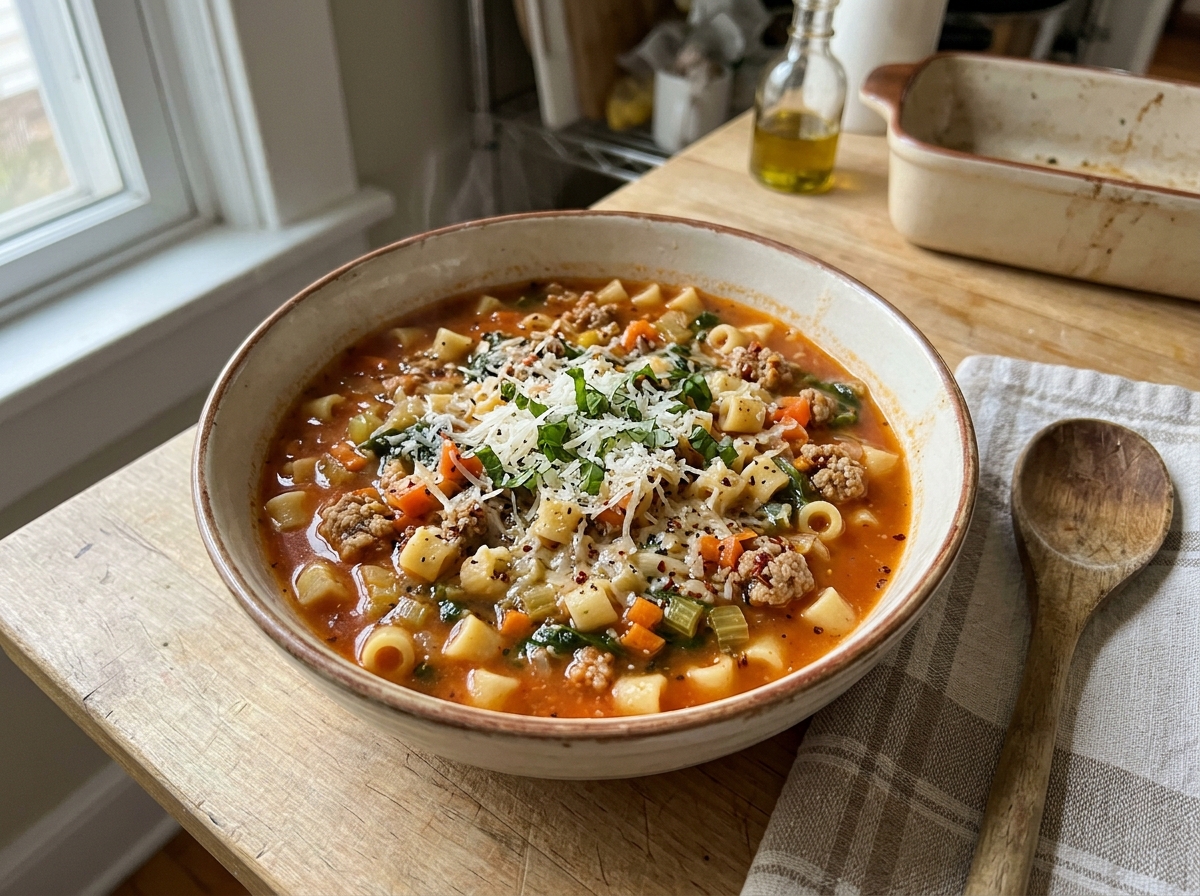
Italian Parmesan Pasta Soup
Ingredients
Equipment
Method
- Heat 1 tablespoon of extra virgin olive oil in a large Dutch oven over medium-high heat.
- Add 1 pound of mild Italian sausage, breaking it apart with a wooden spoon, and cook for 6 to 8 minutes until browned with golden crust edges.
- Remove extra fat with a spoon if desired, leaving approximately 1 tablespoon of rendered fat in the pot.
- Add the remaining 1 tablespoon of olive oil, 1 cup of diced yellow onion, 1 cup of diced carrots, and 1 cup of diced celery to the pot.
- Cook the vegetables over medium heat for 5 to 7 minutes until the onions turn translucent and soft.
- Stir in 4 minced cloves of garlic, 1 teaspoon of dried oregano, 1 teaspoon of dried basil, and 1/4 teaspoon of red pepper flakes, cooking for 1 minute until fragrant.
- Pour in 6 cups of low-sodium chicken broth and 1 can (14.5 oz) of undrained diced tomatoes, scraping up any browned bits stuck to the bottom of the pot.
- Submerge the Parmigiano-Reggiano rind in the broth and bring the mixture to a simmer over medium-high heat.
- Reduce heat to medium-low, cover partially with a lid, and simmer gently for 15 minutes.
- Stir in 1 cup of ditalini pasta and cook uncovered for 8 to 9 minutes, stirring occasionally to prevent sticking, until pasta is al dente.
- Remove the Dutch oven from the heat source and discard the Parmesan rind using tongs.
- Stir in 3 cups of chopped baby spinach, 1/2 teaspoon of black pepper, and 1/2 teaspoon of salt, allowing spinach to wilt for 1 minute.
- Let the soup rest off the heat for 2 minutes, then gradually whisk in 1 cup of freshly grated Parmigiano-Reggiano cheese until smooth.
- Garnish with 1/4 cup of chopped fresh basil and serve immediately.