Peppermint Bark Brownie Crinkle Cookies
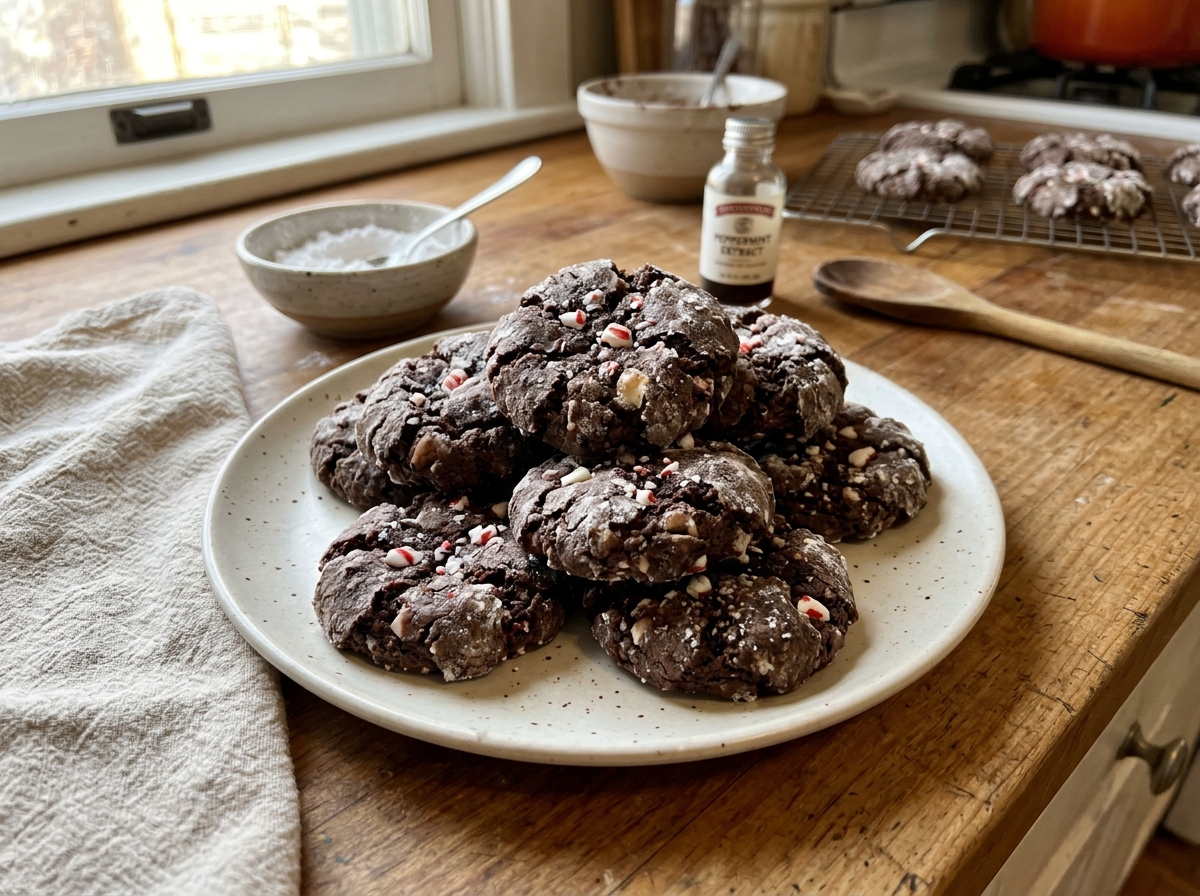
How do you get deep, snowy crinkles on a brownie cookie without the powdered sugar melting into the batter? You roll the dough in granulated sugar before coating it in powdered sugar, and use melted bittersweet chocolate alongside Dutch-process cocoa. This creates a thick, glossy dough that bakes with crisp edges, a dense fudgy center, and bright white peppermint bark contrast.
The Science Behind Deep Crinkles and Fudgy Brownie Centers
Achieving a dramatic crinkle pattern alongside a dense, fudgy interior requires controlling moisture migration and sugar solubility. Standard cookie dough relies solely on cocoa powder for flavor, which can produce a dry, cakey texture. Incorporating melted bittersweet chocolate alongside butter increases total fat and cocoa solids, giving these cookies their distinct brownie-like density.
The double-coating method solves the problem of disappearing powdered sugar. When raw cookie dough bakes, water evaporates and turns into steam. If powdered sugar contacts wet dough directly, steam dissolves the fine sugar crystals into a dull grey syrup before cracks form. Rolling dough balls in granulated sugar first creates a barrier. The coarse granulated sugar draws initial moisture and forms a micro-crust, allowing the top layer of powdered sugar to remain dry and stark white as the cookie expands.
Chilling the batter for a full hour at 38°F to 40°F is equally critical. Cold fat slows spread in the oven. As heat hits the dough, outer edges set fast while internal gases push outward, breaking through the white sugar crust to create deep dark fissures.
Choosing Your Chocolate and Peppermint Ingredients
Selecting quality baking staples determines whether your cookies taste like rich baker’s chocolate or synthetic candy. Here is what to buy and how substitutions impact texture and flavor.
- Bittersweet Chocolate (60-70% Cacao): Provides rich cocoa butter and deep chocolate flavor. Substitution: Semi-sweet chocolate chips work in a pinch. However, chips contain stabilizers that yield a slightly firmer, sweeter cookie with less shiny cracks.
- Dutch-Process Cocoa Powder: Treated with alkali to neutralize natural cocoa acidity, giving a dark black-brown color and smooth taste. Substitution: Natural cocoa powder can be used, though it creates a lighter brown color and adds a mild acidic tang.
- Pure Peppermint Extract: Made from peppermint oil dissolved in alcohol, delivering clean holiday flavor. Substitution: Crushed peppermint candies folded into dough. Note that hard candy pieces melt into sticky caramel pockets during baking rather than flavoring the batter uniformly.
- White Chocolate Chips: Adds creamy pockets that mimic classic peppermint bark. Substitution: Chopped white chocolate baking bars. Chocolate bars melt into broader pools, creating stronger visual contrast.
- Granulated & Powdered Sugars: The dual-coating workhorses. Substitution: Coarse white sanding sugar for the first roll. This gives extra crunch, but powdered sugar adheres slightly less evenly to coarse crystals.
Step-by-Step Cues for Perfect Texture
Relying on sensory cues ensures your cookies reach the correct texture without drying out. Follow these precise benchmarks throughout the process.
- Batter Consistency (Pre-Chill): Freshly mixed batter should resemble thick, glossy chocolate pudding. It will be too soft to scoop or shape with your hands.
- Chilled Dough Cue: After 60 minutes in the refrigerator, dough should feel firm, like cold fudge. A metal cookie scoop should cut cleanly into it without sticking to the sides of the bowl.
- Sugar Application: Press granulated sugar firmly into each dough ball until no dark surface remains visible. When rolling in powdered sugar, tumble the ball twice to build a heavy, opaque coating.
- Baking Doneness: At 10 minutes, look for clear cracks across the top revealing soft centers. Edges should be firm to a light touch, but center domes must still yield under slight pressure. An instant-read thermometer inserted into the side should register between 190°F and 195°F.
Mistakes That Ruin Crinkle Pattern and Fudginess
Small timing or measurement errors can flatten your cookies or dissolve your crinkle pattern. Avoid these standard troubleshooting mistakes.
- Skipping the Granulated Sugar Roll: Dusting powdered sugar directly onto bare dough causes sugar to dissolve within 3 minutes of entering the oven. Always use granulated sugar as your base layer.
- Baking Warm Dough: Warm chocolate batter spreads across the pan before structure sets, producing thin, crispy wafers. Keep unused dough in the fridge while baking the first batch.
- Using Mint Extract Instead of Peppermint: Generic mint extract often contains spearmint, giving baked goods a flavor profile similar to toothpaste. Always check the label for pure peppermint extract.
- Over-Baking Past 11 Minutes: Cocoa powder absorbs liquid quickly. Leaving cookies in the oven until center tops look completely dry turns fudgy interiors dry and crumbly. Carryover heat on the hot pan finishes cooking the centers.
Easy Variations for Every Cookie Platter
Customize this base recipe to fit different diet needs or flavor preferences using these tested adjustments.
- Crushed Candy Cane Topping: Sprinkle finely crushed candy canes over cookies immediately after pulling them from the oven. Press lightly so pieces adhere to hot white chocolate chips.
- Espresso Peppermint Bark Crinkles: Whisk 1 teaspoon instant espresso powder into melted chocolate and butter. Coffee accentuates deep cocoa tones without adding coffee flavor.
- Dairy-Free Peppermint Crinkles: Replace butter with an equal amount of plant-based baking sticks, and select certified vegan dark and white chocolate chips.
- Double Chocolate Mint Crinkles: Swap white chocolate chips for dark chocolate chunks to create an all-dark mint chocolate profile.
Storage, Freezing, and Freshness Guidelines
Proper storage keeps these cookies fudgy for days and allows for convenient make-ahead holiday prep.
Room Temperature Storage: Store fully cooled cookies in an airtight container at room temperature for up to 5 days. Place sheets of parchment paper between stacked layers so powdered sugar coatings do not rub off onto each cookie below.
Freezing Unbaked Dough: Scoop dough into balls and roll through granulated sugar only. Freeze balls on a parchment-lined sheet for 2 hours until solid, then transfer to a freezer bag for up to 3 months. When ready to bake, thaw dough balls at room temperature for 15 minutes, roll heavily in powdered sugar, and bake as directed, adding 1 to 2 minutes to total bake time.
Freezing Baked Cookies: Freeze baked, cooled cookies in a single layer on a tray before packing into freezer-safe containers for up to 2 months. Thaw uncovered on a wire rack at room temperature for 30 minutes before serving.
Frequently Asked Questions
Why did my powdered sugar dissolve on my crinkle cookies?
Powdered sugar dissolves when it absorbs moisture escaping from wet dough during baking. Rolling dough balls in granulated sugar before powdered sugar creates a moisture barrier. Additionally, ensure your dough is thoroughly chilled to 38°F before coating.
Can I make peppermint crinkle cookie dough ahead of time?
Yes, you can prepare cookie dough up to 48 hours in advance. Keep dough tightly covered with plastic wrap in the refrigerator. If dough becomes too stiff to scoop after prolonged chilling, let it sit at room temperature for 10 minutes before shaping.
Why are my crinkle cookies cakey instead of fudgy?
Cakey crinkle cookies are caused by over-baking or using excess flour. Measure flour by spooning it into measuring cups and leveling with a knife. Pull cookies from the oven at 10 minutes while centers still look soft.
Can I use peppermint essential oil instead of extract?
No, peppermint essential oil is far more concentrated than culinary extract and can easily overpower the recipe. Essential oils also react differently with baking fats. Stick to pure culinary peppermint extract for balanced flavor and proper dough structure.
Peppermint Bark Brownie Crinkle Cookies
Ingredients
Equipment
Method
- Heat chopped bittersweet chocolate and cubed unsalted butter in a heatproof bowl over a pot of simmering water, stirring until completely melted and smooth.
- Remove chocolate mixture from heat and let cool for 5 minutes until lukewarm to the touch.
- Whisk 1 cup granulated sugar, eggs, pure peppermint extract, and vanilla extract into cooled chocolate until shiny and smooth.
- Whisk all-purpose flour, Dutch-process cocoa powder, baking powder, and fine sea salt together in a separate medium bowl.
- Fold dry ingredients into wet mixture with a rubber spatula just until no white flour streaks remain.
- Stir white chocolate chips into batter until distributed throughout dough.
- Cover bowl with plastic wrap and chill in refrigerator for 60 minutes until firm.
- Preheat oven to 350°F (175°C) and line two large baking sheets with parchment paper.
- Place remaining 1/2 cup granulated sugar in one shallow bowl and 1/2 cup powdered sugar in a second shallow bowl.
- Scoop 1.5-tablespoon portions of chilled dough and roll between palms into smooth round balls.
- Roll each dough ball thoroughly in granulated sugar to coat completely.
- Roll each sugar-coated ball heavily in powdered sugar until thick white coating forms.
- Arrange dough balls 2 inches apart on prepared baking sheets.
- Bake at 350°F (175°C) for 10 minutes until edges set and cracks form across tops.
- Cool cookies on baking sheet for 10 minutes before transferring to a wire rack to cool completely.