Overnight Breakfast Casserole
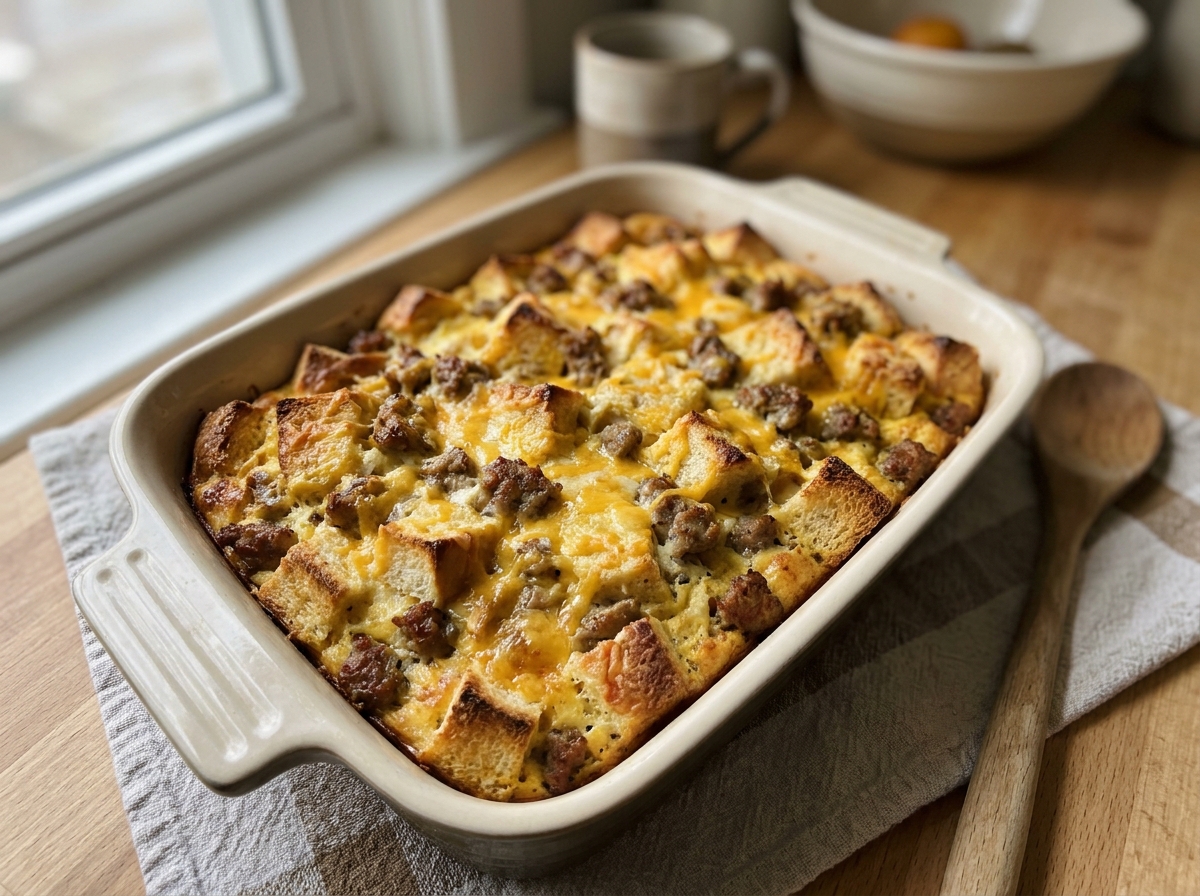
The top of this baked casserole develops a crisp, golden-brown crust of toasted sourdough cubes while the interior sets into a tender, savory egg custard laced with breakfast sausage and sharp cheddar. Leaving the assembled dish in the refrigerator overnight allows the dry bread cubes to absorb the seasoned milk and egg mixture completely, preventing soggy pockets or watery bottoms. We use full-fat whole milk and heavy cream to stabilize the egg proteins so the custard bakes firm without weeping liquid onto the plate.
The Science of a Firm, Golden Breakfast Casserole
A great overnight casserole relies on starch hydration and controlled protein coagulation. When stale bread sits in egg liquid for several hours, starch granules swell and trap the liquid. This prevents the eggs from separating during baking and keeps the casserole structure intact when sliced.
Egg proteins tighten as they heat, pushing out water if cooked too fast or without enough fat. Adding heavy cream introduces fat molecules that coat the egg proteins. This buffers the heat, keeping the cooked egg custard supple instead of rubbery.
Browning the pork sausage completely before layering is equally crucial. Rendering out the excess fat prevents the bottom layer of bread from becoming greasy. The brown bits left in the skillet add deep savory flavor that infuses the egg mixture overnight.
Key Ingredients and Smart Substitutions
Choosing the right ingredients guarantees the casserole bakes evenly with clean slices.
- Day-Old Sourdough Bread: Stale, dry bread absorbs liquid like a sponge without collapsing into paste. Sourdough offers a sturdy crumb and mild tang. Substitution: French bread or challah works well, but reduce resting time by two hours if using soft white bread so it does not turn mushy.
- Ground Pork Breakfast Sausage: Mild or hot breakfast sausage adds seasonings like sage and black pepper throughout the dish. Substitution: Diced cooked ham or turkey sausage can be substituted, though you may need to add 1/4 teaspoon of dried sage to match the traditional flavor profile.
- Sharp Yellow Cheddar Cheese: Aged cheddar provides a bold flavor that cuts through the rich eggs. Shredding it from a block ensures smooth melting without anti-caking starches. Substitution: Gruyère or Monterey Jack melts beautifully, but Monterey Jack delivers a much milder taste.
- Whole Milk and Heavy Cream: A three-to-one ratio of whole milk to heavy cream delivers enough moisture to hydrate the bread while maintaining a rich custard texture. Substitution: Half-and-half works seamlessly as a direct replacement for both. Skim milk should be avoided because the custard will turn watery.
- Dijon Mustard and Ground Nutmeg: A teaspoon of Dijon and a pinch of nutmeg bring out the savory notes of the cheese and eggs without making the dish taste like mustard or spice. Substitution: Dry mustard powder (1/2 teaspoon) can replace Dijon.
Visual Cues for Prep and Doneness
Knowing what to look for at each step ensures your casserole cooks through without burning.
Browning the Sausage: Break up the sausage into small, bite-sized crumbles in a hot skillet over medium heat. It is done when no pink remains and the edges are deeply browned, taking roughly 8 to 10 minutes. Drain off all rendered fat in a colander before assembling.
Soaking the Casserole: Press the top layer of bread down gently with a spatula after pouring the egg mixture over top. Every piece of bread should look damp. After a night in the fridge, the liquid level should drop significantly as the bread absorbs it.
Baking Doneness: Bake covered for the first 30 minutes, then uncover for the final 20 to 25 minutes. The center is fully set when it does not jiggle when you gently shake the dish. An instant-read thermometer inserted into the center should read 160°F (71°C). The edges will pull slightly away from the dish, puffing up with a deep golden surface.
Mistakes That Cause Soggy or Rubbery Casseroles
Avoiding these common errors guarantees a clean slice and rich texture every time.
- Using Fresh, Soft Bread: Fresh bread breaks down into a gummy layer at the bottom of the dish. Always dry your bread cubes in a 300°F oven for 15 minutes if you do not have stale bread on hand.
- Skipping the Chill Time: Baking immediately leaves dry patches in the middle of bread cubes and loose egg custard on the bottom. Give the dish at least 4 hours—preferably 8 to 12 hours—in the refrigerator.
- Pouring Sausage Grease into the Dish: Failing to drain the sausage adds excess oil, causing the liquid to separate and making the bottom crust greasy. Always drain cooked meat thoroughly.
- Baking at Too High a Temperature: High heat causes egg proteins to contract sharply, squeezing out water and creating a rubbery texture. Stick to 350°F (175°C) for even heat distribution.
- Slicing Too Soon: Cutting into the casserole immediately after taking it out of the oven causes the custard to collapse. Rest the pan on a wire rack for 10 minutes so the structure sets.
Flavor Variations to Try
You can adapt this base recipe to suit different dietary preferences or seasonal ingredients.
- Spinach and Mushroom (Vegetarian): Omit the sausage. Sauté 8 ounces of sliced cremini mushrooms and 4 cups of fresh baby spinach in 1 tablespoon of olive oil until moisture evaporates completely before layering.
- Southwestern Bacon and Pepper: Replace sausage with 10 strips of cooked, crumbled bacon. Add 1 cup of diced fire-roasted green chiles and swap cheddar for Pepper Jack cheese.
- Ham and Swiss Brunch: Swap breakfast sausage for 2 cups of diced smoked ham and cheddar for shredded Swiss cheese. Add 2 tablespoons of chopped fresh chives to the egg mixture.
Make-Ahead, Storage, and Reheating Instructions
This dish is designed for prep-ahead convenience and reheats remarkably well for leftovers.
Make-Ahead Instructions: Assemble the complete casserole, cover tightly with plastic wrap or aluminum foil, and store in the refrigerator for up to 24 hours before baking. Pull the dish out of the fridge 20 minutes before baking to take off the chill.
Refrigeration: Cover baked leftovers tightly and keep in the refrigerator for up to 4 days. Slice individual portions for easy reheating.
Freezing: Unbaked casserole can be frozen for up to 2 months. Thaw completely in the refrigerator for 24 hours before baking. Baked slices can also be frozen wrapped tightly in foil and plastic wrap for up to 3 months.
Reheating: Reheat individual slices in the microwave on medium power for 90 seconds to 2 minutes. For larger portions, cover with foil and bake at 325°F (165°C) for 20 minutes until warm through.
Frequently Asked Questions
Can I bake an overnight breakfast casserole right away without chilling?
You can, but the texture will differ. Without chilling, the bread cubes do not fully absorb the egg mixture, resulting in a layer of egg custard at the bottom and drier bread on top. If short on time, let it rest on the counter for at least 30 minutes before baking.
Why is my breakfast casserole watery on the bottom?
Watery bottoms usually stem from excess moisture in vegetables, undrained meat grease, or using low-fat milk. Skim milk lacks the fat needed to bind the custard, while hot sausage grease breaks the egg emulsion. Cook down high-moisture add-ins and drain all meats thoroughly before assembly.
How do I keep the top of the casserole from burning while baking?
Start baking with aluminum foil tented over the baking dish for the first 30 minutes. This traps steam and cooks the center through without scorching the surface. Remove the foil for the final 20 minutes to allow the top layer of bread to crisp and brown evenly.
Can I use hash browns instead of bread cubes?
Yes, thawed frozen hash browns or shredded potatoes can replace bread cubes in equal volume. Keep in mind that potatoes absorb liquid differently than bread, so squeeze out any excess water from thawed hash browns before layering them into the baking dish.
Overnight Breakfast Casserole
Ingredients
Equipment
Method
- Heat a large skillet over medium heat and add 1 lb ground pork breakfast sausage. Cook for 8 to 10 minutes, breaking it into small crumbles with a wooden spoon, until brown and cooked through.
- Drain the cooked sausage thoroughly in a colander lined with paper towels to remove excess fat, then set aside to cool for 5 minutes.
- Grease a 9x13-inch baking dish with nonstick cooking spray or butter.
- Spread half of the sourdough bread cubes (4 cups) evenly across the bottom of the prepared baking dish.
- Scatter the drained cooked sausage and 1 cup of the shredded sharp cheddar cheese evenly over the bread layer.
- Top with the remaining 4 cups of sourdough bread cubes and the remaining 1 cup of shredded sharp cheddar cheese.
- Whisk together 8 large eggs, 2 cups whole milk, 1/2 cup heavy cream, 1 tsp Dijon mustard, 1/2 tsp salt, 1/4 tsp ground black pepper, and 1/8 tsp ground nutmeg in a large mixing bowl until fully combined.
- Pour the egg mixture evenly over the bread and cheese layers in the baking dish.
- Press the top bread cubes down gently with a spatula so all bread pieces are moistened by the egg liquid.
- Cover the baking dish tightly with aluminum foil and refrigerate for at least 8 hours, or up to 24 hours.
- Remove the baking dish from the refrigerator 20 minutes before baking to take off the chill, and preheat your oven to 350°F (175°C).
- Bake covered with foil at 350°F (175°C) for 30 minutes.
- Remove the foil and bake uncovered for an additional 20 to 25 minutes, until the center is set (160°F on an instant-read thermometer) and the top is golden brown.
- Transfer the dish to a wire rack and let it rest for 10 minutes before slicing and serving.